
 Agencies
 Services
Upcoming Macomb Soil Sampling
The Illinois EPA plans to test soil for lead in the neighborhood surrounding the former Haeger Pottery site in Macomb. These efforts are precautionary, after recent environmental sampling off-site the former Haeger Potteries property found lead in the soil at levels above Illinois’ residential safety standards.
Sampling will be conducted during the week of August 24, 2026, weather permitting.
Illinois EPA will sample soil mostly from public right-of-way areas, such as grassy strips between the sidewalk and street, so the Agency can collect the information it needs without entering private property.
Illinois EPA Results from August Soil Sampling
(Results posted September 30, 2026)
Illinois EPA staff took soil samples at 32 different locations, four sample locations had lead levels above the Illinois threshold of 400 parts per million (ppm). These results are from field screening samples used for initial assessment purposes related to the former Haeger Pottery property. All four of these higher‑level samples were located only feet from the facility itself.
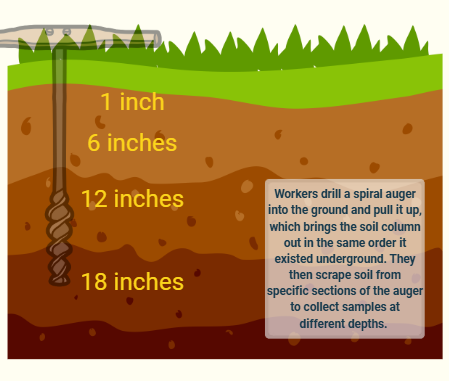
At each location, multiple samples were collected at different depths to understand how contamination changes below the surface.
Three of the elevated sample locations were in front of the vacant facility along Carrol Street. The fourth elevated sample location was located just northwest of the facility on Calhoun Street.
Sample 1 (Carrol Street): Lead measured 522 ppm at 1 inch deep. At deeper levels, concentrations dropped sharply—no lead detected at 6 inches, 84 ppm at 12 inches, and 57 ppm at 18 inches.
Sample 2 (Carrol Street): At 1 inch the lead level was below the Illinois threshold at 265 ppm. However, elevated lead was found at 6 inches (517 ppm), and 12 inches (445 ppm), but decreased to 188 ppm at 15 inches.
Sample 3 (Calhoun St.): Only the 1‑inch sample exceeded the Illinois threshold at 586 ppm. Deeper samples measured 172 ppm (6 inches), 161 ppm (12 inches), and 38 ppm (18 inches).
Sample 4 (Carrol Street): This sample location was in the right‑of‑way directly in front of the Site. Lead measured 1310 ppm at 2 inches and 691 ppm at 4 inches. Due to roots and rocks in the sample location, staff were unable to collect soil deeper than 4 inches. The Illinois EPA is considering this result an outlier due to a combination of factors, including the limited sample depth, which makes it unknown whether lead levels would decrease further down, as well as the sample being located in the facility’s right‑of‑way, meaning it is not representative of community patterns observed in other samples.
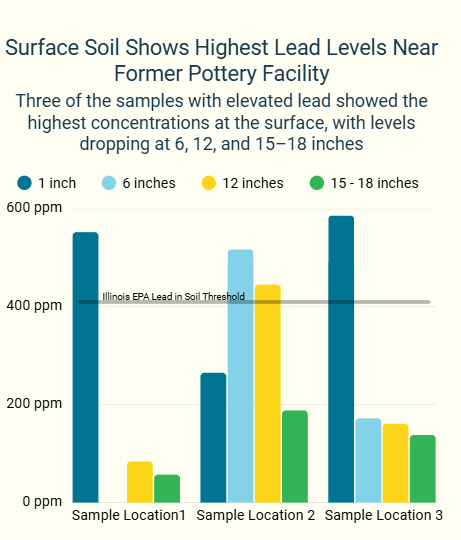
Across the remaining sampling locations, the same pattern was observed: the deeper the soil, the lower the lead levels. This pattern suggests any contamination is more likely due to air deposition rather than buried pottery shards. Air depositions simply refers to lead‑containing particles released into the air during pottery production that drift, settle, and build up on the ground surface over time.
It is also important to note that while Illinois uses a 400-ppm threshold for lead in soil, the U.S. EPA’s regional screening level for residential soil is lower, at 200 ppm. Thirteen sample locations fell between these two thresholds.
Normal, uncontaminated background levels of lead in Illinois soils typically range around 20 ppm. Higher levels can also result from legacy sources like old lead-based paint, historic industrial activity, or past use of leaded gasoline.
If lead is present above 400 ppm, best practices include using raised garden beds with clean topsoil, covering bare dirt with mulch or dense vegetation, and washing hands after outdoor work.
Previous Sampling
The Illinois EPA was made aware of elevated lead levels found recently in soil samples collected just beyond the northwestern boundary of the former Haeger Pottery property. Of the four off‑site soil samples collected in this area, two showed lead levels above Illinois’ residential safety standards.
In Illinois, soil containing more than 400 mg/kg of lead is of concern; the two samples showing elevated lead in soil revealed levels of 3870 mg/kg and 6340 mg/kg. At that time, only one residential property fell within the area where elevated lead was confirmed and Illinois EPA provided the sample results to that property owner through a Right-to-Know notice.
Why Continued Testing is Important
While earlier testing in 2021 identified elevated lead levels in a small area just beyond the northern property line, those results offered only a limited snapshot. Additional lead sampling is needed to determine how far the lead-impacted soil extends, identify where levels may be elevated or within normal ranges, assess whether other areas may require further evaluation, and help determine what types of actions, if any, may be appropriate in the future.
Lead exposure poses a health hazard, particularly to children, if ingested or inhaled in sufficient quantities. In many cases, lead enters the body through breathing contaminated dust, by swallowing contaminated soil, and by eating food that has been grown in contaminated soil and not thoroughly washed.
Exposure to contaminated soil is more dangerous to young children because of their frequent hand-to-mouth activity and their increased susceptibility to lead. Dust from contaminated soil can be tracked into the house on shoes and can end up on indoor surfaces and toys.
Lead can affect almost every organ and system in the human body. The most sensitive area of the body is the central nervous system, particularly in children. Unborn children can be exposed to lead through their mothers. Harmful effects include premature births, smaller babies, decreased mental ability in infants, learning difficulties, and reduced growth in young children. These effects are more common after exposure to high levels of lead.
To learn more about the health risks and ways to reduce your exposure to lead and other contaminants, visit the Illinois Department of Public Heath, by clicking here.
History of Lead in Pottery Production
The former Haeger Pottery site has a long history in Macomb as part of the community’s industrial and manufacturing past. For more than a century, the facility produced pottery and ceramic products, a process that historically involved the use of certain materials that we now know can have long-lasting environmental impacts.
Lead was once a very common ingredient in pottery glazes. For many decades, manufacturers across the country used lead because it helped create bright colors, smooth and glossy finishes, and a strong uniform coating on pottery pieces.
At the time these practices were standard in the industry, the risks of lead in manufacturing settings were not as well understood as they are today. Over years of operation, it was possible for small amounts of lead-containing dust or waste materials such as broken pottery pieces (called “shards”) to enter surrounding soil. Because lead does not break down naturally, it can remain in soil for long periods of time.
What This Means for the Community
The upcoming sampling does not mean every property is affected. Instead, it reflects Illinois EPA’s careful and proactive approach to understanding the full extent of contamination that may have moved beyond the former pottery facility. No immediate action is required from residents.
As we collect this neighborhood-level information, Illinois EPA will share results transparently here on this website and keep the community updated about what we learn and any next steps. If you would like to be notified by email whenever there is an update to this page, including sampling results, sign up here: https://forms.cloud.microsoft/g/GkhAL0eWmr
Frequently Asked Questions
Does this impact the work being done to clean up the actual Haeger Pottery site?
This community soil sampling effort is separate from the cleanup work taking place on the former Haeger Pottery property through the Site Remediation Program (SRP). The SRP is a voluntary program, where an applicant has the opportunity for the Illinois EPA to review, offer technical assistance and provide no further remediation determinations from the Illinois EPA. The SRP program helps the applicant assess and address contamination on the Site itself, following state cleanup standards and requirements for responsible parties. In contrast, the current sampling effort is being conducted by the Illinois EPA and is focused solely on evaluating soil in nearby residential areas to determine whether lead levels meet community health-based standards. These samples are being collected to understand conditions in the surrounding neighborhood not to support or inform the cleanup decisions being made for the Site. While both efforts involve environmental testing, they have different goals, different standards, and are not connected to each other.
How is the city of Macomb involved in the upcoming sampling efforts?
The Illinois EPA reached out to the City of Macomb to help ensure transparency around the upcoming community soil sampling efforts. Because it’s important that residents understand what is happening in their community, the Illinois EPA met with city officials to discuss the best ways to share information, reach affected households, and host an open house where people can ask questions. The city is not directly involved in sampling but has been involved in outreach efforts.
Will I be able to see the results from the July sampling?
Yes. The Illinois EPA plans to post a summary of their findings on this website. For any other documents or material from the Illinois EPA can be obtained through a Freedom of Information Act request or through IEPA Document Explorer.
When can we expect to see results?
Illinois EPA will know test results the day of the sampling. Following evaluation and review, the Illinois EPA anticipates posting a summary of their findings within a month from sampling.
How can I be notified when results or other details are posted?
If you would like to be notified by email whenever there is an update to this page, including sampling results, sign up here: https://forms.cloud.microsoft/g/GkhAL0eWmr
Will you need access agreements to my property?
No. At this time, the Illinois EPA plans to collect soil samples primarily in public rights-of-way, so no access agreements are needed for private property. A public right-of-way is the area that the public and local government have the legal right to use and maintain, most commonly streets, sidewalks, alleys, and the grassy strip between the curb and sidewalk where utilities often run. Because these areas are publicly accessible, sampling can occur there without entering private yards or requesting permission from homeowners. If residents request sampling on their property because of health concerns or pottery shards found in their yards, the Illinois EPA would reach out directly and complete an access agreement before testing any private property.
How will the sampling be conducted?
Illinois EPA will collect soil samples using a small hand auger, which is a tool designed to remove a narrow column of soil from the ground. The auger is turned into the soil to reach approximately 8 inches for testing. The soil is tested above ground and returned to the hole, which is then filled and smoothed over, so the area is left as close as possible to its original condition. This method is quick, minimally disruptive, and commonly used for environmental soil sampling in community areas.
For more information, please contact the Illinois EPA Office of Community Relations.